

 Tiếng Việt
1. What is Monetary Policy?
According to Article 3 of the 2010 Law on the State Bank, monetary policy refers to national-level monetary decisions made by authorized government bodies. This includes setting inflation targets to stabilize the currency and selecting tools and measures to achieve these goals.
Based on this definition, we can understand that monetary policy is a national-level macroeconomic policy, distinct from local policies of lower government levels. Its main objectives are similar to fiscal policy, but its primary focus is on maintaining price stability and controlling inflation.
In Vietnam, monetary policy is enacted and implemented by the Government and the State Bank.
2. Objectives of Monetary Policy
The ultimate goal of monetary policy is to control inflation and promote economic growth. To achieve this, several specific sub-goals are set:
-
Creating Jobs and Reducing Unemployment
Monetary policy affects the money supply in the economy, which in turn influences the equilibrium interest rate in the money market. Interest rates are a crucial factor in business investment and consumer spending decisions. Expanding or contracting these investment activities impacts employment levels.
-
Curbing Inflation and Stabilizing Prices
Curbing inflation involves keeping general price increases within an acceptable range, not exceeding a specific threshold. Price stability aims to keep prices, especially of essential goods, stable to avoid major fluctuations, thus supporting production and daily life.
-
Stabilizing the Financial Market
A stable financial system and effective banking network facilitate the transmission of monetary policy goals into the economy. A stable financial system also supports capital mobilization and allocation, thereby fostering savings and investment for economic growth.

3. The Role of Monetary Policy
Monetary policy plays an essential role in economic management. Through tools like interest rate adjustments and money supply management, central banks can control inflation and stabilize prices, enabling businesses and consumers to plan and invest with confidence. Monetary policy also helps reduce unemployment and drive economic growth by encouraging investment and consumption when interest rates are lowered.
Moreover, it helps maintain financial system stability, manage exchange rates, and protect the economy from economic shocks like financial crises or oil price fluctuations. Effective monetary policy management also builds market confidence, promoting investment and economic activity. Additionally, it works alongside fiscal policy to support the nation's overall economic goals.
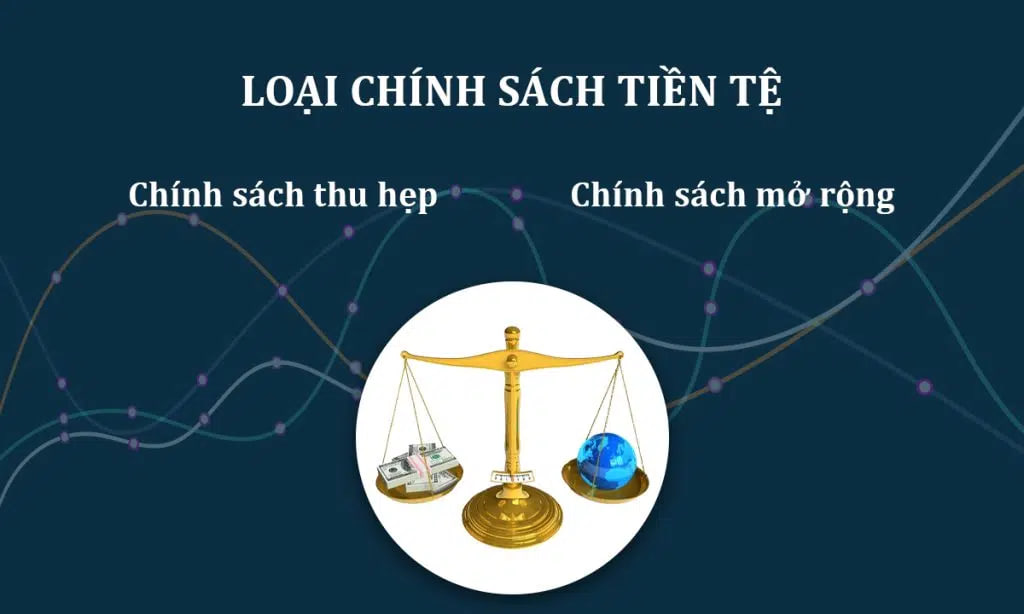
4. Types of Monetary Policy
4.1. Expansionary Monetary Policy
Expansionary monetary policy is when the central bank aims to increase the money supply to stimulate business growth during periods of recession or crisis. This boosts market activity, increases consumer spending, creates jobs, and encourages business activity.
Methods of implementing expansionary policy:
- Lowering the reserve requirement for commercial banks.
- Purchasing bonds and securities on the open market.
- Stimulating lending activities.
4.2. Contractionary Monetary Policy
Contractionary monetary policy is applied when the economy overheats, causing significant inflation. Just as a glass cannot contain a river, an overheated economy requires appropriate measures to cool and adjust.
Methods of implementing contractionary policy:
- Increasing the reserve requirement for commercial banks.
- Selling bonds and securities on the open market.
- Restricting lending activities to absorb excess money from the economy.
5. Monetary Policy Tools
To execute monetary policy, central banks typically use various policy tools to influence the money supply in the economy:
-
Reserve Requirement Tool
Reserve requirements are the portion of deposits that commercial banks must hold according to the central bank's regulations and cannot lend out. This tool not only ensures liquidity but also enables the central bank to manage the money supply by controlling the money multiplier.
Generally, the reserve requirement rate inversely affects the money supply: raising the requirement reduces the money supply, and vice versa. Thus, to expand monetary policy and increase the money supply, the central bank may lower the reserve requirement rate. Conversely, to tighten policy, it raises this rate for commercial banks.
-
Open Market Operations (OMO)
Open market operations involve the buying or selling of short-term securities (such as T-bills) between the central bank and commercial banks.
To expand monetary policy, the central bank buys these securities, creating money to pay banks, increasing lending capacity and the money supply. Conversely, to tighten monetary policy, it sells these securities.
-
Discount Rate Tool
This tool adjusts the discount rate at which the central bank loans to commercial banks. When the central bank lowers the discount rate, commercial banks reduce their reserve requirements, increasing the money supply.
-
Refinancing Tool
This tool provides credit from the central bank to commercial banks, boosting money supply and providing additional capital for commercial banks, thus expanding their payment capacity.

6. The Crypto Market and Challenges to Monetary Policy
The rise and continual development of cryptocurrencies like Bitcoin have posed significant challenges for global monetary policymakers in controlling inflation and maintaining financial system stability.
.jpg)
.jpg)
.jpg)
.jpg)

.jpg)